Views: 0 Author: Site Editor Publish Time: 2026-08-13 Origin: Site
Purchasing a commercial aesthetic device ranks as one of the highest capital expenditures for growing medspas and dermatology clinics. You face a crowded market boasting flashy claims and confusing specifications. Clinic owners must evaluate complete budget requirements over time. You cannot look at just the initial sticker price. Relying solely on the upfront invoice often creates dangerous cash flow traps later. Equipment downtime and expensive maintenance contracts quickly erode profit margins.
We skip the marketing fluff here. This guide provides a transparent, evidence-based breakdown of equipment costs. You will discover hidden operational fees and realistic return on investment timelines. By understanding these long-term expenses, you secure a confident purchasing decision. We help you align clinical capabilities directly against your business goals. You will learn exactly how to budget for maximum profitability.
Commercial machine costs range wildly based on technology, power output, and manufacturing origin.
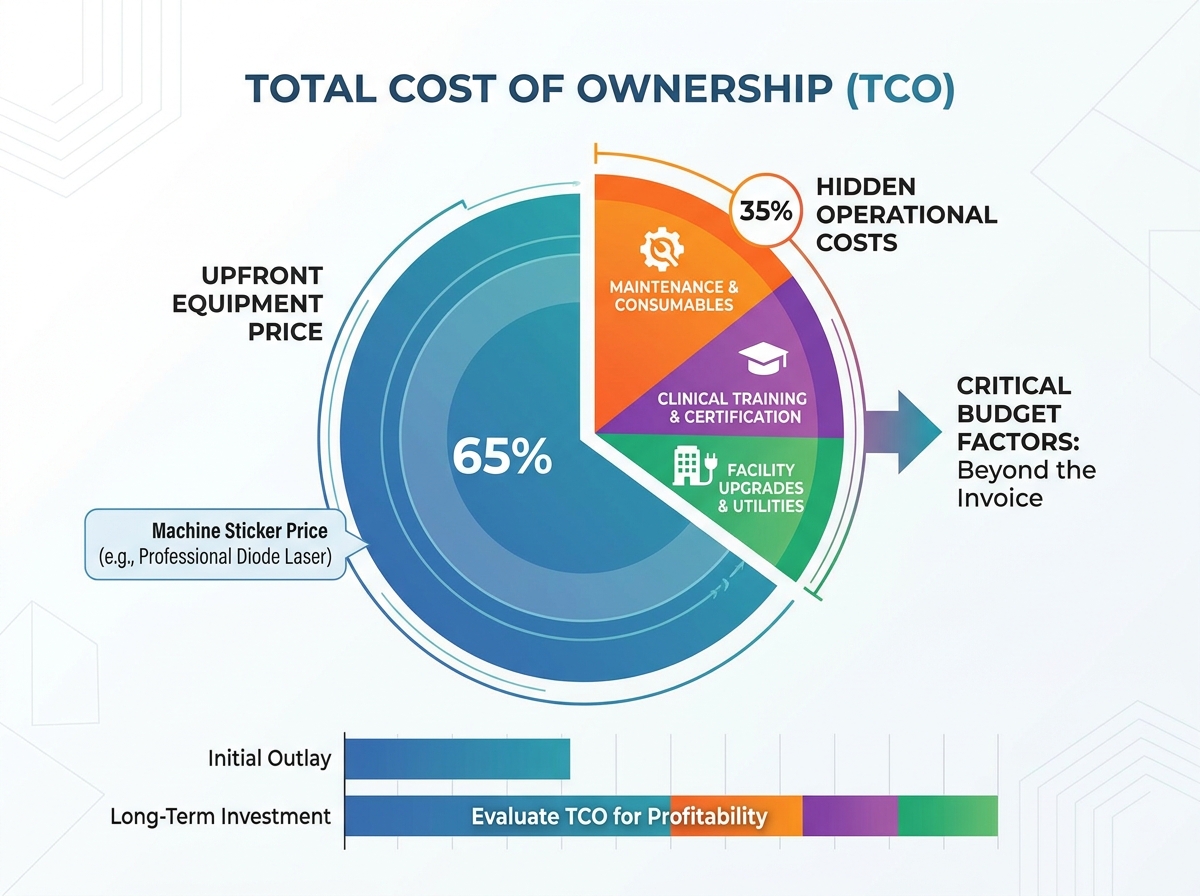
Upfront equipment price is only 60-70% of the true investment; budgeting must include clinical training, maintenance, and facility upgrades.
A Professional Diode Laser Hair Removal Machine currently offers the most balanced cost-to-profit ratio for diverse skin types.
FDA/CE compliance and warranty structures are non-negotiable evaluation metrics that dictate long-term profitability.
Clinic owners frequently ask about baseline prices. We must provide transparent ranges to help you set realistic budgets. The market segments into three primary tiers. Each tier reflects different component qualities and support structures. Understanding these tiers prevents you from overspending or buying an underpowered device.
Entry-level devices appeal to new clinics operating on strict budgets. These machines usually come from overseas manufacturers. They feature lower wattage and simpler cooling mechanisms. While the price looks attractive, you must evaluate the risks.
Lower wattage means you might need more sessions to achieve clinical endpoints. We often see reliability issues in this tier. Handpieces may degrade faster. You rarely receive robust clinical support or rapid maintenance responses. Budgeting for an entry-level unit requires setting aside extra cash for unexpected repairs.
This category represents the sweet spot for most successful medspas. These reliable workhorses handle high daily patient volumes. You typically receive solid warranties and adequate power output.
A high-quality Professional Diode Laser Hair Removal Machine usually sits in this price bracket. Manufacturers in this tier invest heavily in component durability. You gain access to better user interfaces and stronger cooling systems. The initial investment is higher, but the cost per treatment drops significantly over time.
Flagship systems cater to high-end dermatology practices and specialized clinics. They offer multi-wavelength platforms. You can treat various skin concerns beyond simple hair reduction.
These devices feature advanced proprietary cooling systems. However, you also pay a steep premium brand markup. If your clinic processes dozens of patients daily, the efficiency might justify the cost. For smaller spas, the premium features rarely generate a proportionate increase in revenue.
You might consider refurbished units to save money. A refurbished premium Laser Hair Removal Machine often costs the same as a new mid-tier device.
The initial savings look great on paper. Yet, refurbished models carry inherent risks. You might face expired warranties. Manufacturers sometimes discontinue parts for older models. You must weigh the upfront discount against potential downtime if a critical component fails.
Baseline Equipment Pricing Breakdown
Equipment Tier | Price Range | Typical Profile | Best Fit For |
|---|---|---|---|
Entry-Level | $10,000 – $30,000 | Imported, lower power, basic cooling | Strictly constrained startup budgets |
Mid-Tier | $30,000 – $60,000 | Reliable power, solid warranties, durable | High-volume medspas, expanding clinics |
Premium | $65,000 – $100,000+ | Multi-wavelength, top brand markup | Specialized dermatology centers |
The underlying physics of your chosen device directly dictates its manufacturing cost. Different wavelengths target specific depths and melanin concentrations. We categorize solutions by technology to match them against your target demographic. This alignment ensures you do not overpay for unnecessary capabilities.
This technology currently dominates the mid-tier market. Diode Laser Hair Removal offers exceptional cost-efficiency. Manufacturers produce these solid-state lasers reliably and affordably.
They boast incredible durability. A single handpiece can deliver millions of shots before requiring replacement. Furthermore, they provide high safety margins across varied skin types. You can confidently treat Fitzpatrick I-V patients. This versatility makes them highly profitable for general medspas.
Alexandrite (755nm) and Nd:YAG (1064nm) systems cost significantly more to manufacture. They utilize expensive crystal rods and complex flashlamp mechanisms. Their maintenance expenses run higher due to frequent consumable replacements.
These machines serve clinics targeting specific demographic extremes. Alexandrite excels at treating very light, fine hair. Nd:YAG remains the gold standard for very dark skin (Fitzpatrick VI). If your local demographic requires these extremes, the higher price tag becomes a necessary business expense.
Many budget-conscious buyers look at IPL devices. These machines utilize broad-spectrum light rather than a focused laser beam. They cost drastically less than true lasers.
However, you should never budget an IPL device as your primary clinical tool for this service. IPL produces inferior clinical outcomes. Patients experience more discomfort and require more sessions. Unsatisfied patients leave negative reviews. We strongly advise against substituting a cheap IPL for a dedicated laser platform.
Inexperienced buyers stare at the invoice price. Experienced clinic owners look at implementation realities. We must expose the expenses lurking beyond the initial equipment purchase. Budgeting correctly here prevents devastating financial surprises during your first year of operation.
Every aesthetic device consumes materials. You must factor these into your monthly operational budget. Depending on your chosen technology, these expenses vary widely.
Flashlamps and Emitters: Solid-state diodes last millions of pulses. Crystal-based lasers require flashlamp replacements much sooner.
Handpiece Lifespans: Manufacturers program strict shot count limits into handpieces. Once you hit the limit, you must buy a refurbished or new handpiece.
Cooling Agents: Some premium systems use consumable cryogen gas canisters. These empty quickly during busy weeks.
Servicing Contracts: Annual preventative maintenance plans cost thousands of dollars. Skipping them voids your warranty.
Delivering professional Hair Removal Treatment safely requires certified technicians. You cannot simply hand a powerful medical device to an untrained staff member.
Budget for initial vendor training. Most reputable manufacturers include a basic training package. However, you must also budget for staff turnover. When your lead technician quits, you must pay to certify a replacement. State regulations may also require you to hire a licensed medical director to oversee operations. These compliance costs add up quickly.
Commercial clinical equipment draws massive amounts of electricity. You cannot plug these machines into a standard wall outlet. Most high-powered systems require dedicated 220V circuits.
You must hire an electrician to upgrade your treatment room. Additionally, these machines generate immense heat. A dedicated HVAC mini-split might be necessary to keep the room comfortable. You also need regulatory safety gear. This includes wavelength-specific safety eyewear for staff and patients, plus proper exterior warning signage.
You need a practical framework to evaluate your investment. A high price tag matters less if the machine generates exceptional daily revenue. We guide clinics to justify their purchase based on realistic patient volume projections.
Do not rely on manufacturer ROI calculators. They always assume ideal conditions. We prefer a skeptical, realistic formula. You must calculate how many treatments you need per month just to keep the lights on.
Use this simple calculation: (Monthly Equipment Payment + Monthly Maintenance Reserve + Staff Hourly Wages) divided by (Average Profit per Treatment). The resulting number tells you exactly how many sessions you must book. If the required number seems impossibly high for your market size, you are looking at an overly expensive machine.
Your local market saturation dictates your pricing power. You cannot charge premium Manhattan prices in a rural suburb. Research your local competitors thoroughly.
If five local spas offer the exact same service, prices will drop. This directly affects the payback period of a high-end machine. You might need to compete on volume rather than margins. Ensure your chosen equipment can handle back-to-back appointments without overheating.
How you pay impacts your cash flow dramatically. Paying cash eliminates interest but drains your liquid capital.
Capital leases allow you to own the machine at the end of the term. Operating leases offer lower monthly payments, but you return the equipment later. Both financing options preserve your cash for marketing and payroll. Furthermore, purchasing commercial equipment often qualifies for Section 179 tax deductions. You can deduct the full purchase price from your gross income. Always consult your accountant before signing a final contract.
You narrowed down your budget. You understand the hidden expenses. Now, you must evaluate individual suppliers. We established authoritative evaluation criteria to help you make a confident, risk-averse decision. Buying a Laser Hair Removal System demands rigorous vendor scrutiny.
Never compromise on regulatory compliance. You must verify FDA clearance in the United States or CE marking in Europe.
Uncertified machines carry massive legal liabilities. If a patient suffers a burn from an uncertified device, your malpractice insurance will deny the claim. You risk losing your entire business. Demand to see the actual clearance documentation. Do not accept screenshots or verbal promises.
Patient retention drives aesthetic clinic profitability. If a treatment hurts too much, patients will not return for their remaining sessions.
Evaluate the integrated cooling technology carefully. Sapphire contact cooling draws heat away from the epidermis instantly. Cryogen sprays offer intense bursts of cold. Chilled air systems blow freezing air across the skin. Superior cooling allows you to use higher energy settings safely. This improves clinical results while keeping the patient comfortable.
The Service Level Agreement (SLA) dictates your operational security. A broken machine generates zero revenue.
Evaluate the warranty terms strictly. What is the guaranteed response time? We recommend demanding a 48-hour service window. Ask if they provide a loaner handpiece while yours undergoes repair. A comprehensive SLA protects your reputation. You never want to cancel a full day of appointments because technical support will not return your call.
Untrustworthy suppliers share common warning signs. You must walk away if you spot them.
Unverifiable Specifications: If they claim impossible power outputs for a tiny desktop machine, they are lying.
No Local Technicians: If they must fly a technician from another country to fix your device, your downtime will stretch into weeks.
Reluctance to Provide Clinical Data: Reputable manufacturers happily share whitepapers and before-and-after photos. Evasion indicates poor clinical efficacy.
Proper budgeting requires looking far beyond the initial purchase price. The right budget aligns clinical capabilities with your specific business model. You must account for consumables, facility upgrades, and maintenance contracts. Cutting corners on regulatory clearance or warranties always leads to long-term financial pain. Choose a robust system supported by a transparent service agreement.
Next Steps: First, audit your facility’s electrical and HVAC setup. Second, define your exact target demographic to select the correct wavelength. Finally, request transparent, itemized quotes from two or three vetted manufacturers. Ensure these quotes include complete Service Level Agreements before you sign any paperwork.
A: A high-quality commercial device lasts 5 to 7 years with proper maintenance. However, individual handpieces degrade faster. Diode handpieces typically last for 10 million to 20 million shots. Once you reach the maximum shot count, you must refurbish or replace the handpiece to maintain clinical efficacy.
A: Refurbished machines save upfront capital but carry moderate risks. They are worthwhile only if purchased directly from the original manufacturer or a certified dealer. You must secure a comprehensive warranty and guarantee that replacement parts remain in active production. Avoid third-party sellers lacking dedicated service technicians.
A: Compliance regulations vary drastically by region. Many states and countries classify these devices as Class II or Class III medical equipment. They often mandate oversight by a licensed medical director (such as an MD or DO). Always consult your local medical board to ensure legal compliance before opening.
A: Diode lasers boast excellent cost-efficiency. Your primary ongoing expenses include conductive ultrasound gel, medical-grade sanitization wipes, and disposable safety items. You must also budget for an annual preventative maintenance inspection. Unlike crystal-based lasers, diodes do not require expensive flashlamp or cryogen gas replacements.